If seawater gets very cold, what happens to its density?
Density
Densityis a measure of how much mass there is in a given volume or amount of infinite. The density of whatsoever substance is calculated by dividing the mass of the matter by the volume of the matter.
 |
In Fig. 2.2, volume is represented past boxes and individual particles of matter are represented past colored shapes.
- Box A has five spheres.
- Box B is the aforementioned size, and has the same book as box A, merely box B has x spheres.
- Box C has the same mass as box A, with five spheres, but box C has a larger volume than boxes A and B.
- Box D has the same volume and number of green spheres as part A, but also includes other types of thing than the rest of the boxes—scarlet circles and blueish cubes.
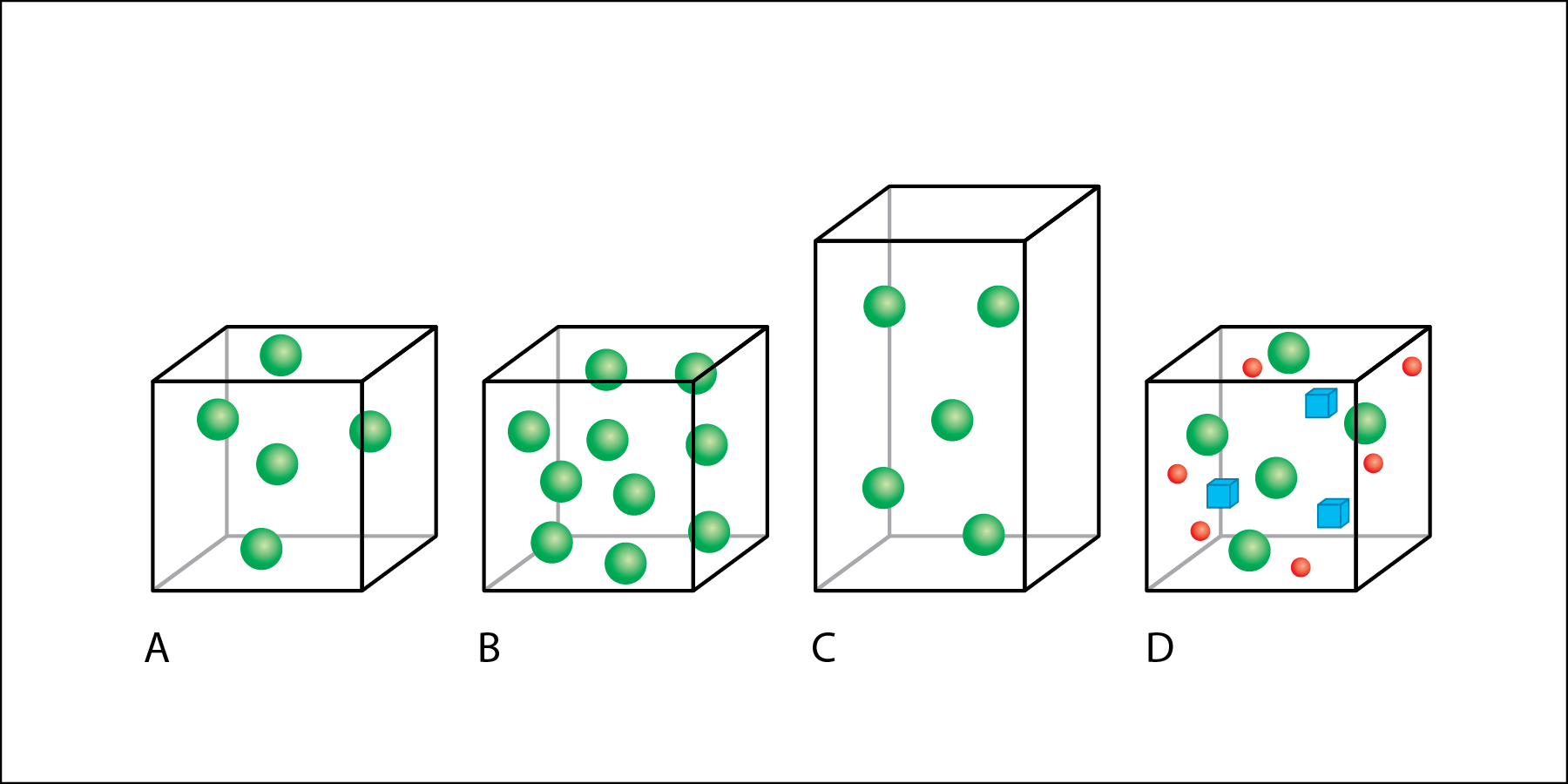
If the corporeality of thing is increased without changing the volume, and then the density increases (Fig. two.2 A to 2.2 B). If book increases without an increase in mass, then the density decreases (Fig. 2.2 A to 2.2 C). Adding additional matter to the aforementioned book also increases density, even if the matter added is a different type of affair (Fig. ii.ii A to 2.ii D).
Salinity Affects Density
When salt is dissolved in fresh water, the density of the water increases considering the mass of the water increases. This is represented by the add-on of cherry-red spheres and blue cubes to the box from Fig. 2.two A to Fig. 2.2 D. Salinity describes how much salt is dissolved in a sample of water. The more salt at that place is dissolved in the water, the greater its salinity. When comparing two samples of water with the aforementioned book, the water sample with college salinity volition have greater mass, and it will therefore be more dense.
Temperature Affects Density
The density of water can also exist afflicted by temperature. When the same amount of water is heated or cooled, its density changes. When the water is heated, information technology expands, increasing in volume. This is represented past the increase in the size of the box from Fig. 2.2 A to 2.2 C. The warmer the water, the more space it takes upward, and the lower its density. When comparing two samples of water with the same salinity, or mass, the water sample with the higher temperature will have a greater volume, and it will therefore be less dense.
Relative Density
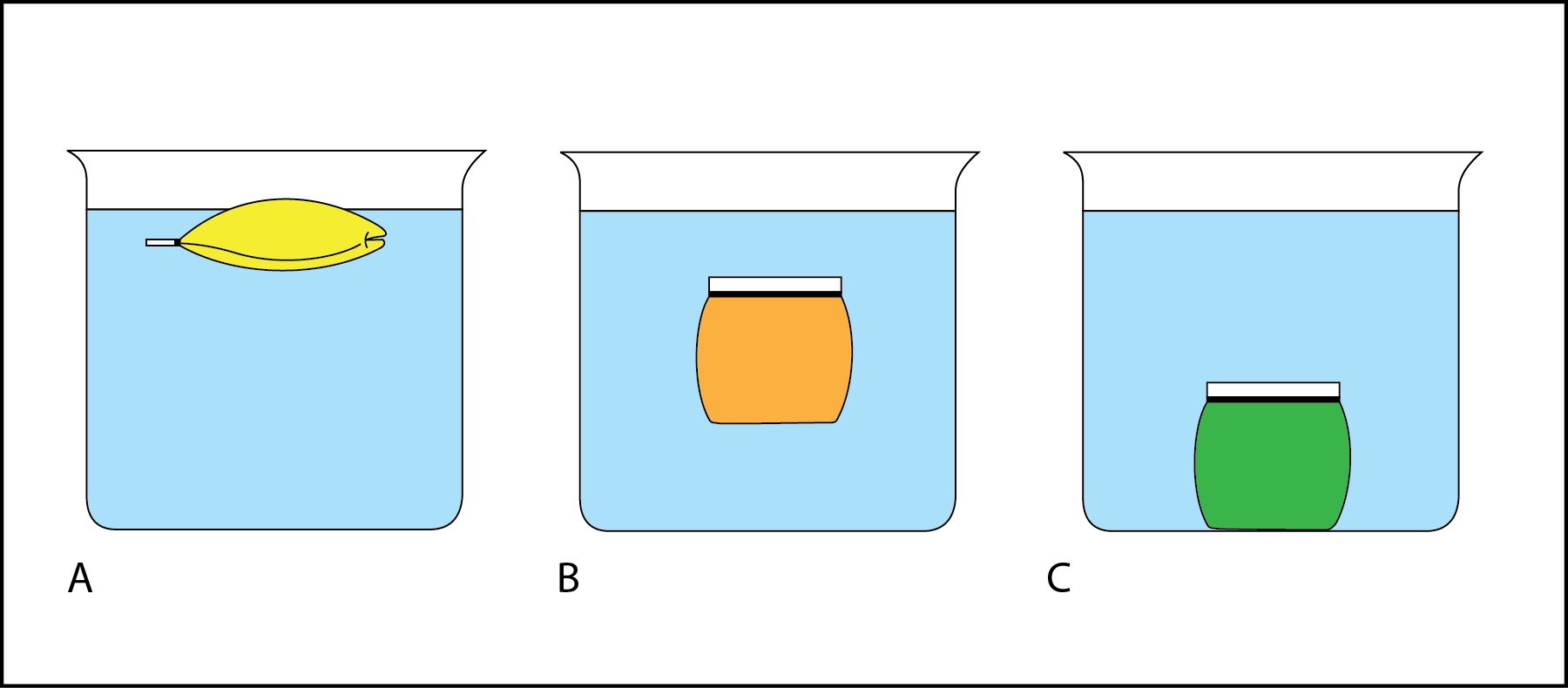
In Fig. two.iii, the beaker of liquid models a trunk of water similar the ocean or a lake. The purse of liquid simulates a layer of water. The relative density of the liquid in the bag compared to the liquid in the beaker can be determined by observing whether the handbag sinks or floats.
- In Fig. 2.iii A, the bag rose to the top of the chalice and is at present floating on the surface. The yellowish liquid and the bag are less dense than the liquid in the chalice.
- In Fig. 2.three B, the bag is floating in mid-water (subsurface floating). The orange liquid and the handbag are equal in density to the liquid in the beaker.
- In Fig. ii.3 C, the bag sank to the bottom of the chalice. The green liquid and the bag are more than dense than the liquid in the beaker.
Activity: Density Bags
Exam the furnishings of salinity and temperature on the floating and sinking of liquid samples in bags.
Water Layers
If water masses have salinity or temperature differences, they will form water layers considering they take unlike densities. H2o layers tin can sometimes be felt when pond. For example, on hot days the sun'south heat can make water at the surface noticeably warmer than the deeper, libation water. The relative density of one water mass in relation to another determines whether a layer of h2o floats or sinks.
Density and Buoyancy
Density can exist adamant past measuring the mass and volume of an object. In the Density Bags Activeness, density was non calculated. Instead, relative density was determined by observing whether a pocketbook of one liquid floated or sank in some other liquid. A pocketbook of liquid that sank was determined to be more dense than the liquid in the beaker. A bag of liquid that floated was determined to be less dense than the liquid in the beaker.
Image past Byron Inouye
" title="
">
The motility of any object is due to forces , which are pushes or pulls. Vertical—up-and-down—movement of water masses in the ocean can be explained in terms of two forces. The gravitational force (Grand) of the globe pulls downward and is proportional to the mass of an object. In Fig. 2.5, the gravitational force (G) is proportional to the mass of the cerise block. The gravitational forcefulness on an object is besides called weight . The forcefulness due to gravity is greater on objects that are more massive, or counterbalance more. The buoyant force (B) of water pushes up. In the third century B.C., the Greek philosopher Archimedes was the first to depict buoyancy. He observed that the book of h2o pushed out of a tub, or displaced, by an object was equal to the volume of the object. The buoyant force of the water is equal to the weight of the h2o displaced. This concept is known every bit Archimedes' Principle , and it explains why objects sink or float. In Fig. ii.5, the buoyant strength (B) is equal to the weight of the h2o displaced past the ruddy block.
An object accelerates when the forces on that object are unequal. Although acceleration is ordinarily used to describe an object that is speeding up, the scientific definition of acceleration ways irresolute speed. An accelerating object can be speeding up or slowing downward. An object volition always move in the management of the greater force. An object may accelerate downwards (sink) or upwardly (rise) in a trunk of water.
- Sinking is a downward vertical movement that occurs when the gravitational force (G) on an object is greater than the buoyant force (B) supporting it (G > B).
- Rising is the upward vertical movement that occurs when the gravitational force is less than the buoyant force (G < B).
If all of the forces on an object are balanced, in that location is no acceleration. In this case, the object may not move—like a book sitting on a flat table—or the object may move at a constant speed—like a car traveling at a steady 80 kilometers per 60 minutes. In the water, an object might remain still either at the surface or within the water column.
- Surface floating occurs when an object stays at the surface, because the forces are counterbalanced at the surface (Thousand = B).
- Subsurface floating, or neutral buoyancy, occurs when an object maintains its position in mid-water, neither sinking nor rising (Thou = B).

Iii cubes of the same size, but with unlike masses and thus unlike densities, are placed in three beakers of water (Fig. 2.6). Because the cubes are identical in volume, they displace the same amount of water. By Archimedes' Principle, the buoyant forcefulness (B) acting on each cube is equal. Buoyant forcefulness is represented in Fig. ii.six as upward pointing arrows, indicating the water is pushing upwards on the cubes. These arrows are the same length for each of the cubes, indicating that the forcefulness of the buoyant strength acting on each cube is the same.
Because the masses of the cubes are not equal, the gravitational force (Yard) acting on each cube is different. Gravitational force is represented in Fig. ii.six as downwardly pointing arrows, indicating the gravitational force is pulling downward on the cubes. These arrows are different lengths for each cube, indicating that the amount of the gravitational force is different for each cube. The downwards pointing arrow in Fig. 2.6 A is the shortest, indicating that the yellow cube has the least mass and is the least dense. The downwards pointing arrow is the longest in Fig 2.half dozen C, indicating that the green cube has the well-nigh mass and is the most dense.
The density of the cube relative to the density of h2o determines if the cube will float, sink, or exist neutrally buoyant:
- If the density of the cube is less than the density of the water, gravitational force will be less than the buoyant force (G < B), and the object will ascension to the surface (Fig. 2.six A).
- If the density of the cube is equal to the density of the water, the cube volition float in center of the column of h2o considering the gravitational strength and buoyant force are balanced (G = B). This cube is neutrally buoyant (Fig. 2.half dozen B).
- If the density of the cube is greater than the density of the h2o, the cube will sink because the gravitational forcefulness is greater than the water's buoyant force (G > B) (Fig. 2.6 C).
Source: https://manoa.hawaii.edu/exploringourfluidearth/physical/density-effects/density-temperature-and-salinity
0 Response to "If seawater gets very cold, what happens to its density?"
Post a Comment